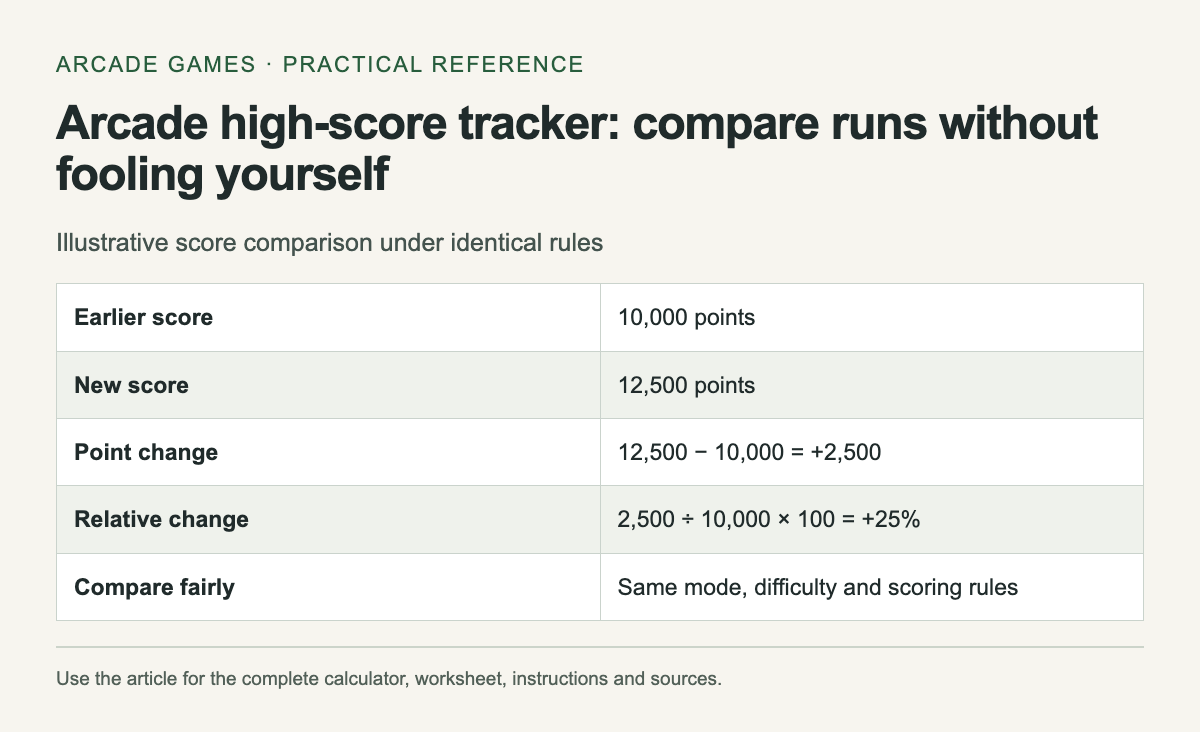
A new high score is easy to celebrate and surprisingly easy to misread. Before comparing it with an older run, check the mode, difficulty and scoring rules. A longer run with extra starting lives is useful progress, but it is a different comparison from a run under identical conditions.
Keep a small log with the date, rules and one observation. You do not need to record every button press. The note should explain what you want to repeat or change next time, such as a missed bonus route or a risky move that cost a life.
Calculate the change
Compare two scores
Change = new score − earlier score. Percentage change = change ÷ earlier score × 100. Compare identical modes and rules.
The calculator compares two numbers. It does not know whether they came from the same game, a seeded challenge or different versions. If lower numbers are better, as in a completion-time challenge, label the result accordingly instead of calling every positive percentage an improvement.
Keep the comparison fair
Record the mode and difficulty beside every score. Add starting lives, continues used and any modifiers that affect scoring. If an update changes the rules, start a new group of results instead of mixing the old and new records without a note.
For games with random layouts or spawns, expect runs to differ for reasons beyond your decisions. You can still track scores, but avoid treating one exceptional result as proof that a new tactic always works. Repeat the approach under the same available conditions and compare a small set of runs.
Track consistency as well as the record
After several comparable attempts, sort the scores and look at the middle value. For an even number of attempts, average the two middle values. This median gives you a simple way to describe a typical recent run without letting one unusual result dominate the summary.
A hypothetical set of 8,000, 9,000, 9,500, 10,000 and 18,000 has a median of 9,500. The 18,000 record remains worth keeping, but it should not become the only number you use to describe normal performance. These figures are an arithmetic example, not measured results from a named game.
Add one useful observation
Write the first mistake that clearly changed the run. "Lost a life entering the narrow section" is actionable; "played badly" is not. If you cannot identify a cause, leave it uncertain and watch that section during the next attempt.
You can also record a success. A route that consistently keeps you alive may be worth retaining even if it produces fewer early points. The right choice depends on the scoring rules and whether your current goal is survival, completion or a record attempt.
Choose the next session’s task
Pick one observation to work on and keep the rest of the setup stable. If you change the control layout, route and difficulty together, your next score will not tell you which change mattered. Separate exploratory sessions from attempts you intend to compare closely.
Save the log somewhere you control. This page's calculator does not retain your numbers after you leave, so copy a result into your own notes if you want it later. A few dated entries with clear rules are more useful than a large collection of unexplained score screenshots.
For an older arcade title in the archive, see the Chicken Invaders 3 archive entry.


No comments:
Post a Comment