Showing posts with label Arcade Games. Show all posts

Monday, October 19, 2026

Luck be a Landlord Beginner Guide: Choose Symbols for Rent

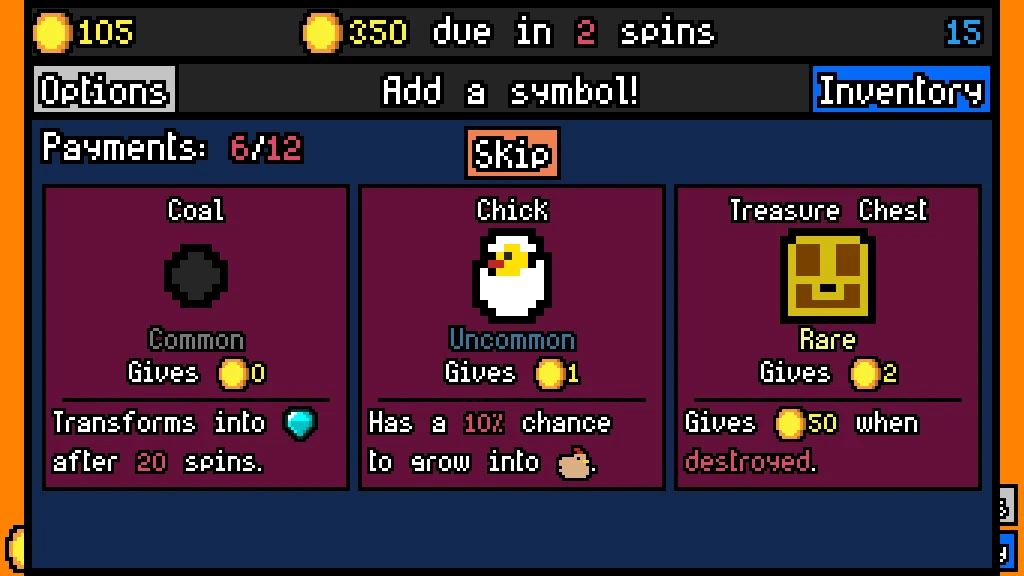
Official Luck be a Landlord screenshot offering Coal, Chick and Treasure Chest symbols beside the Skip button.

In Luck be a Landlord, a promising symbol can still be a poor choice for the rent payment immediately ahead. Before adding it, check what it earns now, what it needs to work and how long its payoff takes. This beginner guide provides a symbol-choice checklist and a simple way to review a failed run without assuming that every loss came from bad luck.

The game is a roguelike deckbuilder built around a fictional rent-paying slot machine. The developer confirms that it contains no real-money gambling or microtransactions in the official press kit. Its changing symbol and item offers create different combinations from run to run; their individual effects and interactions are described on the official Steam page.

My recommendation is to judge a new symbol against the next rent payment before imagining a future combination. I would give a delayed reward more room once the immediate payment is covered; when it is not, the missing partner or extra spins are a cost to account for now.

Read the rent display before choosing a symbol

Start with three numbers on your screen: current coins, rent due and spins remaining. A rough target is the unpaid rent divided by remaining spins. This is a planning aid, not a prediction of what your next spin will earn. Random outcomes and changing interactions mean an average requirement cannot guarantee success.

For a hypothetical example, suppose you have 80 coins, owe 140 and have three spins left. You need another 60 coins, or 20 per remaining spin on average. A choice with a delayed reward needs to be judged against that immediate gap. If you already hold enough coins for the payment, you have more room to consider a longer-term combination.

When no spins remain, stop using the calculation and compare your balance directly with the payment. Do not divide by zero or treat the next rent period's opportunities as money you have already earned.

Compare effects, not just rarity

The press screenshot above illustrates a useful decision. It offers symbols with different kinds of payoff: a delayed transformation, a chance to grow and a reward that depends on destruction. The precise values shown belong to that official screenshot; check the descriptions in your installed version before choosing.

Ask what would have to happen for each offer to help. A conditional reward deserves a follow-up question: do you already have an effect that can meet its condition? A symbol that might work with a future offer is a speculative choice. Write down that missing piece instead of counting the whole imagined combination as current income.

Questions to ask before accepting a symbol
CheckLook forDecision it informs
Immediate outputThe symbol's base payout and current effectsWhether it can help with the next payment.
Required partnerA named symbol, item or event in its descriptionWhether the interaction is already supported.
DelayA spin count, transformation or growth conditionWhether the reward can arrive soon enough.
Trigger wordingTerms such as adjacent, destroyed or chanceWhat must happen before the bonus applies.
Existing collectionYour inventory and item descriptionsWhich offer fits what you actually own.
SkipThe available Skip choiceWhether any offer has a clear purpose in this run.

Use a short routine between spins

  1. Check the rent gap and remaining spins.
  2. Open your inventory if you cannot remember the relevant symbols or items.
  3. Read the full wording of the most promising offer, including its trigger.
  4. Choose it for a stated reason, or consider skipping when none of the offers supports your plan.
  5. Watch the next result and identify whether the expected interaction occurred.

Keep the reason specific: “works with an item I already own” is more useful than “looks strong.” You do not need to calculate every possible outcome. The routine is meant to catch missed conditions and expensive delays before you commit.

Review one decision after a failed payment

Record the payment you missed, how far short you were and one earlier selection you would reconsider. Separate an interaction that never became active from one that was active but paid inconsistently. Those suggest different changes: the first needs better selection evidence, while the second may need a larger income margin.

Use our run tracker to retain that one useful observation. For a short next session, the practice planner can give you a narrow goal such as reading every trigger before accepting a symbol. A single result will not establish a best build; several recorded decisions can show which conditions you repeatedly overlook.

Official Luck be a Landlord press screenshot of a symbol choice. Values shown are from the supplied press image; check your installed game. Image: TrampolineTales.


Sunday, October 18, 2026

Peglin Beginner Guide: Plan Shots and Choose Upgrades

Metal ball between cream flippers on a bright pastel pinball table.

In Peglin, pause before each shot to choose what the orb needs to accomplish. You might want immediate damage, a route through a dense patch of pegs or access to a useful special peg. Picking that purpose first makes it easier to understand why a shot worked and what to change after a poor one.

Red Nexus Games describes Peglin as a pachinko-style roguelike: hitting more pegs builds damage, orbs and relics have special effects, and defeat ends the run. Its official Steam page also identifies critical hits, refreshes and bombs as tools to use deliberately. These beginner tips focus on those decisions without prescribing a fixed build.

Read the orb before aiming

Check the current orb's description and damage information before choosing a path. A route that suited the previous orb may do little for this one. If an effect depends on a condition, ask whether you can reasonably trigger it on the board in front of you.

Compare two possible openings. One might hit several nearby pegs reliably; another might head towards a special peg but depend on a difficult bounce. Look at the first contact and the likely direction afterwards. You do not need to predict every collision to identify a shot that starts by dropping through an empty gap.

After firing, watch where the route stopped working. Was the first angle wrong, was the useful part of the board already sparse, or did you expect an effect that the orb did not have? Give the mistake a name before the next shot.

A pre-shot decision table

Choose a purpose for the current orb
What you seeWhat to checkPossible priority
Many reachable pegsFirst bounce and gaps below itA path with several likely contacts
A sparse part of the boardReachable refresh option and current orb effectA route that helps restore useful contacts
A reachable critical pegThe orb's critical damage or special conditionCritical access when it benefits this orb
A bomb near your routeWhether the route still serves the current fightInclude the bomb if the detour is worthwhile
An unfamiliar orbIts full descriptionTest one effect you can observe clearly
A risky angled shotThe simpler alternativePrefer the route whose first contacts you understand

Choose upgrades for a problem you have

When an upgrade or a new orb is available, name the weakness you want it to address. Perhaps your current choices depend too much on awkward angles, or a useful effect rarely activates. Read what the offered option changes, then judge it against that specific weakness.

Do the same with relics. An attractive description is only part of the decision; you also need to know which part of your current run benefits. If you cannot explain the connection in a sentence, compare the other options before committing. This is a learning habit, not a claim that unfamiliar choices are always bad.

A hypothetical example: if an upgrade improves an orb you already understand and use effectively, it is easier to evaluate than a new effect whose conditions you have not learned. You can still choose the unfamiliar effect for practice. Record that choice as an experiment so a failed run tells you something useful.

Reassess as the map changes

Peglin's official description says each run has a new map with different encounters and rewards. Avoid planning around a sequence you saw in a previous attempt. At a route choice, consider your current health, the options displayed and whether your recent fights suggest you can handle more risk.

For your first attempts, choose one thing to practise rather than changing everything at once. Try reading each orb before firing for a full run, then focus on recognising weak opening angles in the next. Our short practice-session planner can help you keep that goal small enough to finish.

Keep a useful record after defeat

  1. Write down where the run ended.
  2. Describe one recurring problem with your shots or choices.
  3. Note an orb or relic interaction you understood better.
  4. Choose one adjustment for the next attempt.

Keep those notes beside your run tracker. Record the mode and any settings that change the challenge before comparing attempts. A longer run is useful evidence, but so is identifying why a particular shot repeatedly leaves you with little damage. On the next attempt, test that observation before adopting another unfamiliar strategy.

Original editorial pinball illustration representing bounce-based play; not a Peglin screenshot. Peglin uses pachinko-style gameplay.